




A bed is the most intimate object in a home. It is where the day releases you, where rest becomes possible, where you return to yourself each morning. To make a bed beautifully is not vanity — it is an act of hospitality toward your own life, a daily reminder that you deserve softness and care.
The art of layering a bed is ancient in spirit if not in name. Travelers across centuries have known the particular comfort of a bed built in layers — foundation, warmth, cover, and flourish — each element chosen for both its beauty and its purpose. Understanding how to layer a bed thoughtfully is less about decoration than about creating a sense of ease and restoration.

The Foundation: Sheets
Every beautiful bed begins at the base. Sheets should feel generous and breathable — their texture is the first thing you notice when you slip beneath the covers. Choose materials that suit your climate and your body: crisp percale for those who sleep warm, silkier sateen for those who love a more enveloping feel. A coherent palette — soft whites, warm linens, muted naturals — creates the calm foundation upon which everything else rests. In any luxury bedding guide, this foundational layer is what determines whether a bed feels merely attractive or genuinely restorative.

Duvet or Comforter: The Main Layer
The duvet and the comforter are the heart of the bed — the layer that offers warmth and determines the overall mood. A duvet, with its removable cover, invites change: a linen duvet cover in summer, a heavier quilted one in winter, a new pattern whenever the spirit moves you. A comforter offers its own charm — sewn together, unchanging, quietly reliable. Neither is superior; the question is simply what kind of relationship you want with your bed.
The duvet vs comforter difference ultimately comes down to flexibility versus simplicity — one designed for seasonal transformation, the other for permanence and ease.
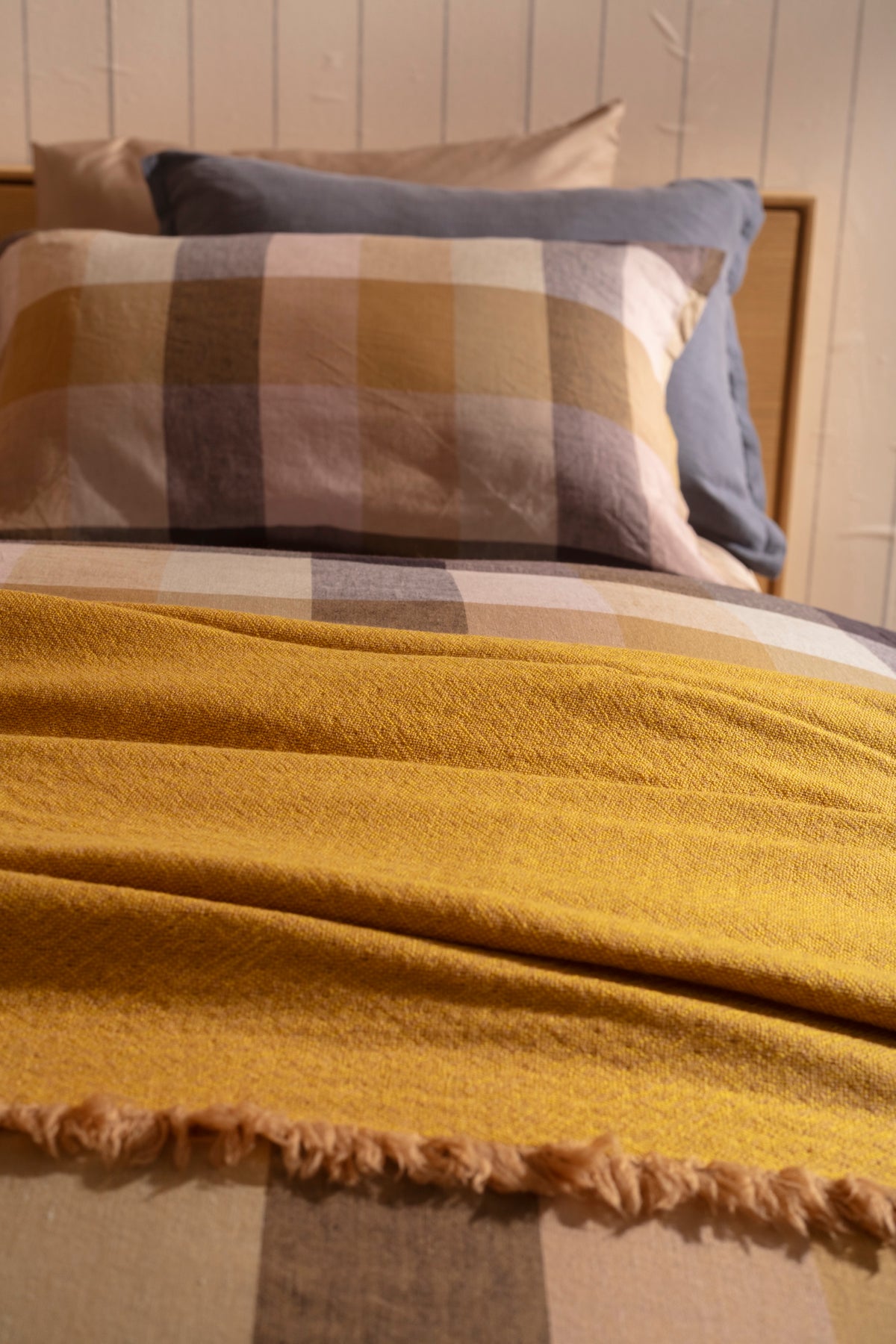
The main layer should feel full without being heavy — let it drape naturally, folded slightly at the top to reveal the sheet layer beneath, its texture visible and inviting.

Pillows: Structure and Softness
Pillows are where the bed becomes a composition. On a king bed, a considered arrangement might include two or three sleeping pillows, a pair of Euro shams standing tall behind them for height and structure, and one or two decorative pillows in front — perhaps in a contrasting texture, perhaps simply in a beautiful color. The goal is proportion, not abundance. Too many pillows looks performative; too few feels unfinished.
For those wondering how many pillows for a king bed create the right balance, restraint is often what makes the arrangement feel luxurious rather than excessive.
Euro shams, large and square, provide the architectural backbone of the arrangement. Standard shams layer in front of them, bridging sleeping comfort and decorative intent. Used together, they create the sense of depth that distinguishes a considered bed from a merely made one. The conversation around Euro shams vs standard shams is not about choosing one over the other, but understanding how they work together to create structure and softness in equal measure.

The Throw: A Final Note of Character
A throw draped across the foot of the bed is the detail that makes a bed feel inhabited rather than staged. Lay it casually, asymmetrically — as though it has been reached for and set aside. Coordinate its tones with the pillow arrangement rather than matching exactly. Let it be soft in a different way than the duvet, textured where the duvet is smooth, nubby where the sheets are crisp.
Understanding how to layer a bed with a throw and shams is often what transforms a functional bed into one that feels deeply considered and welcoming.

Texture Over Matching
The secret of a truly beautiful bed is texture, not color coordination. A bed that combines crisp cotton sheets with a soft, lofty duvet, structured Euro shams with a relaxed linen throw — this is a bed that rewards the eye and invites the body. It does not require expensive pieces, only thoughtful ones, chosen with the understanding that contrast and variation are what make a composition feel alive.
This is how the great hotels do it: not through excess, but through precision — a limited palette, materials of quiet quality, an arrangement that feels effortless because every choice was intentional. It is also how to style a bed like a hotel: layered textures, careful restraint, and softness that feels inviting rather than ornamental.
Many contemporary stylists, including those inspired by John Robshaw bedding styling tips, understand that a beautiful bed is built through texture, artisanal detail, and an ease that never feels overly arranged.
In the end, how to make a bed look expensive has very little to do with extravagance. It comes instead from proportion, material, layering, and the quiet confidence of pieces chosen with intention.
